Size and space
Gong Size Guide: Centimeters, Inches and Everyday Fit
Choose a diameter that gives you the presence you enjoy while leaving comfortable room for the instrument and its support. Smaller sizes favor everyday convenience; larger sizes make a stronger visual statement. The conversion table and existing visual size reference make the available options easier to picture.
Gong sizes in centimeters and inches
One inch equals 2.54 centimeters, so divide centimeters by 2.54 to get inches. NIST’s length reference defines the inch as 25.4 millimeters. The inch values below are rounded to one decimal place.
| Diameter in centimeters | Approximate diameter in inches |
|---|---|
| 20 cm | 7.9 in |
| 30 cm | 11.8 in |
| 40 cm | 15.7 in |
| 50 cm | 19.7 in |
| 60 cm | 23.6 in |
| 70 cm | 27.6 in |
| 80 cm | 31.5 in |
| 90 cm | 35.4 in |
| 100 cm | 39.4 in |
| 120 cm | 47.2 in |
| 150 cm | 59.1 in |
| 200 cm | 78.7 in |
| 250 cm | 98.4 in |
These are conversions of width, not predictions of weight or sound. The visual size reference gives another straightforward view of scale alongside the product options.
A small increase in diameter can change the presence
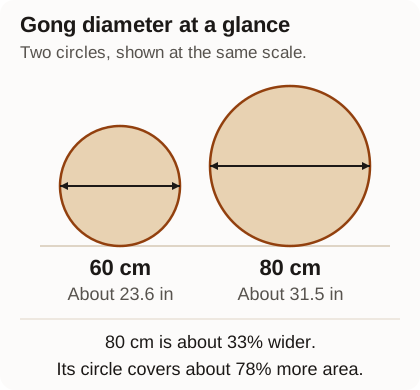
Diameter describes width, but the area inside a circular outline grows with the square of its radius. A change from 60 to 80 cm increases the width by one third and the area inside the outline by about 78 percent. This helps explain why the larger circle can feel substantially more prominent.
That calculation is about visual scale. It does not mean 78 percent more volume or weight. A shaped gong has depth and varying geometry, so the circle alone does not describe the whole object.
For an interior, this offers a useful distinction. A smaller diameter can feel quietly integrated with furniture and other objects. A larger one can become the room’s focal point. Both are good choices when they express the presence you want.
A gong used for meditation or personal ritual does not have to be large to hold significance. Its place in your practice can come from intention and familiarity as much as scale. Choose a larger size because you enjoy its presence and have space for it, rather than treating size as a measure of spiritual or musical value.
Leave comfortable room around the gong
The circular width is only part of the setup. A freestanding support also occupies floor space, and the instrument needs room to move. A position that leaves easy access and an unhurried playing stance will feel better in daily use than one fitted tightly between other objects.
Paiste’s manufacturer guidance illustrates two useful principles: its gongs should move without hitting the frame, and suspension cord needs periodic inspection. Use appropriately rated support and its installation instructions when setting up your instrument.
For a room with several uses, a moderate size is an easy preference. For a dedicated position, you may welcome a larger circle and the visual focus it creates. There is no need to assign a diameter to the room’s square footage. The instrument’s intended place in the room is more useful than a room-size formula.
If you plan a wall or overhead mounting, suitable hardware and installation remain essential. An outline fitting on the wall does not establish a fixing’s load capacity. The choice of diameter and the eventual safe installation are different parts of ownership.
Diameter is not an exact note
In McLachlan’s research on gong geometry, shape and thickness affected vibrational behavior in ways a diameter alone could not describe. A width chart should not be read as a chart of guaranteed notes or sustain times.
The representative recordings already on the site can introduce the sound character if you would like to hear it. Let the preview inform your attraction, and choose the scale that feels appropriate to your intended space.
Thai Gongs instruments are made to order. The existing audio introduces the sound family, and your finished instrument brings its own handcrafted voice. Choose the size and finish you enjoy, with room for that individual character.
The buying guide explains the relationship between sound, appearance and personal resonance in more detail.
Convenience is a good reason to choose smaller
If the instrument will stay in a permanent position, a larger size can be an appealing focal point. If you expect to move it regularly, store it between uses or share the room with other activities, a smaller diameter can make everyday ownership more convenient.
Leave room in your budget for appropriate support and any protection you choose for travel. The gong’s diameter is not the footprint of a complete setup. A little space around the instrument makes ordinary handling more comfortable.
Our preference when two sizes appeal equally is simple: favor the smaller one for mobility and flexibility, or the larger one for presence in a generous permanent space. Neither choice represents a higher level of practice. The best instrument is one that has a welcome place in your life.
Choose an available size and the finish you enjoy
You can make this a straightforward online choice. The collection presents the listed diameters and finishes, with the existing sound previews if you want them. Use the scale reference for perspective and your own sense of the room for the final choice.
The ordering FAQ and cancellation and returns policy explain the published terms. Choose an instrument for its sound family, its appearance and the meaning it may hold in your practice.
Explore the gong collection and select the diameter that feels at home in your space.
Sources & editorial notes
Researched by Thai Gongs Editorial. Sources accessed October 21, 2026. See our editorial approach and research limits.
- SI Units – Length. National Institute of Standards and Technology. Exact inch definition; the table uses calculated conversions rounded to one decimal place.
- Finite Element Analysis and Gong Acoustics. Neil McLachlan · Acoustics Australia, 1997. Geometry and thickness affect vibrational behavior; no catalog pitch or sustain predictions are inferred.
- Gong support, suspension and handling. Paiste. Manufacturer guidance on free movement and suspension inspection; installation follows the instructions for the equipment used.