Thai instruments
Types of Thai Gongs: Names, Instruments and Musical Roles
Thai gongs include single suspended instruments, paired gongs and complete sets arranged around a musician. The useful distinction is their job: marking rhythm, playing a melody or signaling an event. A large hanging bossed gong and a khong wong yai belong in the same conversation, but they are different instruments to learn, hear and buy.
Arrangement and function reveal different instruments
For readers interested in instrument names, arrangement and musical role offer a useful way to explore the variety of Thai gongs. The Thai musical reference entry for khong separates gongs used for rhythm from gongs used for melody. It also describes the raised central boss, the surrounding face and the turned rim. These physical features connect instruments with different musical roles.
The comparison below is a reading aid assembled from the linked Thai references. It is organized around the arrangement and musical role a newcomer can recognize in published descriptions and performances. For individual instruments at named sacred places, explore our separate guide to notable gongs at Thai temples.
| Name | Visible arrangement | Useful first distinction |
|---|---|---|
| Khong wong yai: ฆ้องวงใหญ่ | 16 gongs in a horizontal circle | A melodic set; identify the whole instrument. |
| Khong wong lek: ฆ้องวงเล็ก | 18 gongs in a smaller horizontal circle | A higher melodic counterpart, not a miniature hanging gong. |
| Khong mong: ฆ้องโหม่ง | A gong suspended vertically | A rhythmic instrument; listen for its placement in the ensemble. |
| Khong Mon: ฆ้องมอญ | Multiple gongs on a frame curving upward | Retain the Mon name and musical context. |
| Khong khu: ฆ้องคู่ | Two gongs on a short support | A paired instrument, not an incomplete circle. |
| Khong rabeng: ฆ้องระเบ็ง | Three gongs suspended in a row | A named relationship to rabeng performance. |
Read the individual sections before using the table to identify an unfamiliar object. Compare the visible arrangement with published collection records and performance descriptions. A photograph provides a useful starting point, while the documented musical context helps distinguish similar forms.
Khong wong yai and khong wong lek: two melodic circles
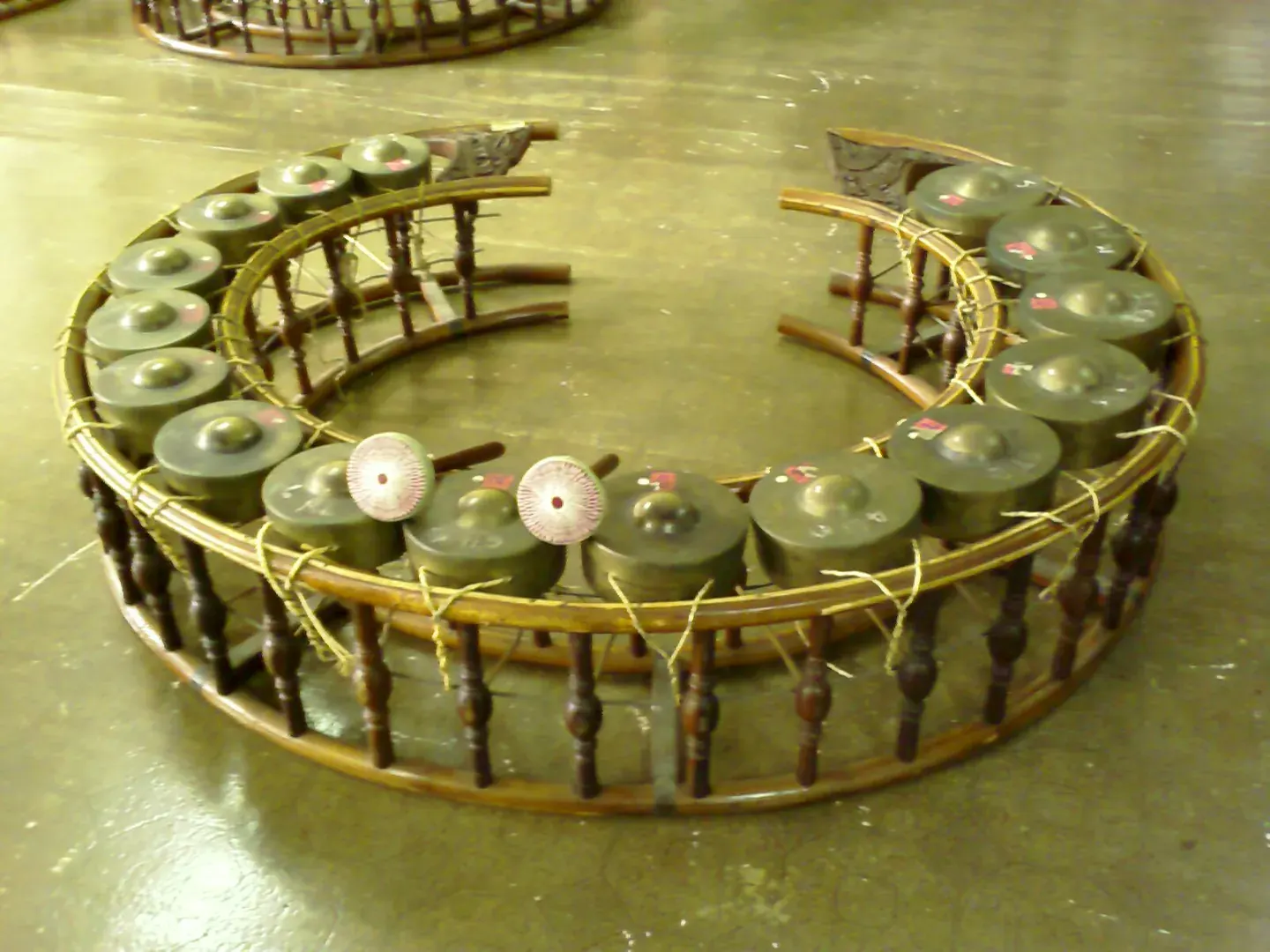

The Thai musical encyclopedia’s khong wong entry describes graduated gongs arranged horizontally around a seated player, with the lower pitches on the player’s left. It distinguishes the 16-gong khong wong yai from the smaller 18-gong khong wong lek. In ensemble playing, the yai provides the foundational melody; the lek contributes a more elaborated part in a higher register. Both require a player to navigate a set of pitches with two beaters.
This matters when someone says they want a “Thai gong” for music. Do they want a single sound to punctuate a piece, or an instrument on which to learn a melodic repertoire? Those are different projects. A hanging gong may be entirely suitable for the first. For the second, the arrangement and musical relationships of the full set are central to the decision.
Do not read “large” and “small” as a quality ranking. Here they distinguish two related instruments with different roles. Nor should a shopper assume that assembling independently purchased gongs of different diameters will recreate a working circle. For Thai ensemble study, follow teaching materials for the named instrument. A circle’s musical relationships are part of that study; a size chart alone cannot explain them.
Khong mong: a single suspended gong with a rhythmic job
The khong mong entry describes a vertically suspended gong with a long-resonating tone, used to mark rhythm in ensembles including piphat, string ensembles and mahori. It explains that its placement differs with the ensemble: the pattern used alongside long drums is not simply the same placement repeated everywhere.
Khong mong shows how a sustained tone can carry both character and rhythmic purpose. Listening within the ensemble reveals the relationship between its sound and the music around it. The space between strikes can be as interesting to follow as the resonance itself.
English spellings vary across catalogues and academic writing. Retain the Thai name ฆ้องโหม่ง as an anchor when comparing published sources. A familiar outline does not establish a complete identification. Use the name when the source identifies that instrument in context; “single bossed gong” is a useful broader description when discussing the visible form.
For personal playing, choose a style and size from the single gongs in our catalogue. The existing sound previews are an optional way to hear the collection’s general character. Our handcrafted gongs are made to order, with individual character; the clips are representative. For more detail about the options, explore the gong buying guide.
Khong Mon: recognize the upright curve
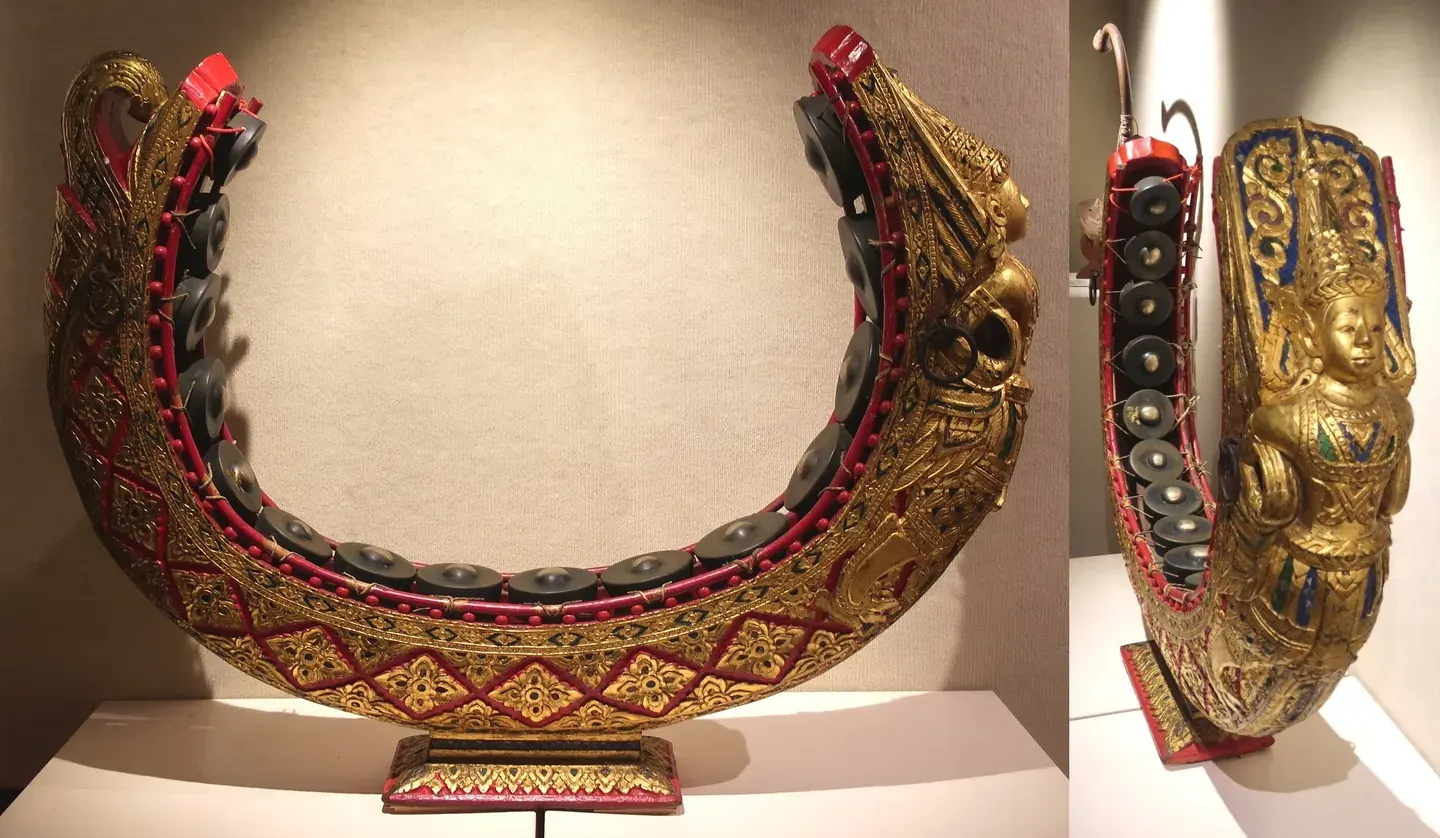

The encyclopedia’s khong Mon entry describes a gong set whose frame curves upward at both sides, rather than lying flat like the Thai horizontal circle. The frame can be richly carved, gilded and decorated with mirror work. The instrument belongs to piphat Mon. Its visible architecture is a more useful first clue than an elaborate surface decoration on an unrelated gong.
Keep “Mon” in the name to retain the connection between the visible form, its community history and its musical practice. Anant Narkkong’s Department of Cultural Promotion essay describes Southeast Asian music as both locally distinctive and shaped by continuing exchanges among communities across political borders.
For a listener, this suggests a rewarding discipline: identify the ensemble and the community as carefully as the instrument. The frame invites attention to visual artistry, while the performance opens a path into its musical setting. Our guide to gongs in Thai ritual explores documented contexts, including central Thai funerals.
Paired gongs and three-gong rows deserve their own names
Khong khu is a pair of gongs with different pitches, mounted with their bosses upward on a short wooden support. The Thai reference connects it with southern shadow-puppet theatre and Nora Chatri performance. Two gongs can therefore constitute a complete instrument with a specific role, rather than a reduced version of a larger melodic set.
Khong rabeng, also described by its row arrangement as khong rao, comprises three suspended gongs of different sizes and pitches. The reference explains their alternating relationship with sung phrases in rabeng performance. Here the name tells you about a performance relationship as well as a physical object.
These examples are a reason to resist a simple ladder from “one gong” to “more advanced gong set.” Number alone tells you little about the learning involved. Listen for the player’s responsibility: a rhythmic entrance, a recurring pattern, a melodic foundation or a response to singing. Recognizing that role makes a performance more intelligible and helps distinguish a single instrument from a complete set.
Two documented museum examples worth comparing
Yale’s gong, accession 1010.1972, is catalogued as a late nineteenth-century Thai bronze nipple gong. The record gives a front diameter of 51 cm, a depth of 7.5 cm, two suspension holes and an A-flat pitch designation. These observations describe one accessioned object and give us a concrete example of the form.
Compare that with The Metropolitan Museum of Art’s twentieth-century Khong Wong Yai, object 1986.467.27a–c, recorded as Thai and made from wood, metal and cord. The contrast is immediately educational: one record concerns a single suspended gong; the other concerns a multi-part musical instrument.
The lesson is about reading the record closely. An alloy, pitch, date or dimension belongs to the documented object unless the source explicitly makes a broader claim. The instrument’s arrangement also matters: a description of a khong wong yai refers to the complete set, even if a single hanging gong shares some visible features.
Accession numbers, cultural attributions, date ranges and descriptions let you appreciate each object’s documented history. They also show where a collection leaves questions open. Reading those details is a satisfying way to explore an instrument’s place in the wider tradition.
Choose a single gong, or explore the music more deeply
For your own practice, browse our single bossed gongs, choose a style and size, and place your order online. You can listen to an existing preview if you like. The gongs are handcrafted and made to order, each with individual character.
Your gong can become part of musical exploration, quiet listening or a personal ritual. The gong size guide and playing guide offer optional detail as you explore those possibilities.
If you enjoy exploring ensemble performances, the traditions above offer another rewarding path. Listen for the player’s task: moving across pitches, marking a recurring point or responding to another performer. This optional framework can help you follow a recording:
- Identify the object. One gong, a pair, a row or a circle?
- Identify the role. Melody, rhythm, a signal, or a combination within this performance?
- Identify the context. Who is playing, where, and for which event?
- Read the description. Does a collection record or published performance account identify the instrument and explain its role?
If your interest is producing sustained sound through friction, continue to rubbing a gong for meditation for an explanation of the method and its limits.
Sources & editorial notes
Researched by Thai Gongs Editorial. Sources accessed October 21, 2026. See our editorial approach and research limits.
- ฆ้อง: Khong (gong). Encyclopedia of Thai Musical Terms, third edition, hosted by NECTEC. Anatomy and distinction between rhythmic and melodic gong functions.
- ฆ้องวง: Khong wong (gong circles). Encyclopedia of Thai Musical Terms, third edition, hosted by NECTEC. Horizontal arrangement, 16-gong yai, 18-gong lek, and their contrasting musical roles.
- ฆ้องโหม่ง: Khong mong. Encyclopedia of Thai Musical Terms, third edition, hosted by NECTEC. Suspended rhythmic gong, sustained tone, and differing rhythmic placement in ensembles.
- ฆ้องมอญ: Khong Mon. Encyclopedia of Thai Musical Terms, third edition, hosted by NECTEC. Upright curved frame, decoration, and use in piphat Mon. Count is deliberately not generalized.
- ฆ้องคู่: Khong khu (paired gongs). Encyclopedia of Thai Musical Terms, third edition, hosted by NECTEC. Two different pitches on a short support; use in southern shadow theatre and Nora Chatri.
- ฆ้องระเบ็ง: Khong rabeng. Encyclopedia of Thai Musical Terms, third edition, hosted by NECTEC. Three suspended gongs and alternating sung phrases in rabeng performance.
- Here ASEAN Soul, Hear ASEAN Sounds. Thailand Department of Cultural Promotion; text by Anant Narkkong. Related but distinct Southeast Asian musical cultures and the circulation of instruments across borders.
- Gong, accession 1010.1972. Yale Collection of Musical Instruments. Late nineteenth-century Thai bronze nipple gong, suspension holes, documented dimensions and pitch.
- Khong Wong Yai, object 1986.467.27a–c. The Metropolitan Museum of Art. A twentieth-century Thai gong circle made with wood, metal and cord; not a single hanging gong.