Meditation & technique
Rubbing a Gong for Meditation: Friction, Sound and Care
A suitable rubber friction mallet can make a gong sound as it moves across the surface, without a conventional strike. Use this technique only when the published instructions for your gong and mallet explicitly support it. If they do not, skip rubbing and begin with a gentle padded-mallet strike. Either approach can give you a sound to follow in meditation.
Three practices that are easy to confuse
“Rubbing a gong” can describe different actions. Identifying the instrument and the contact point is more useful than copying the movement from a short video.
| What you see | What is happening | What to check |
|---|---|---|
| A rubber ball on a thin handle moves over a gong face | A friction mallet, sometimes called a flumi or superball mallet, sustains sound through rubbing. | Compatibility of the mallet material and gong finish. |
| A stick circles the open rim of a bowl | This is singing-bowl playing, with a different instrument and contact surface. | The bowl maker's recommended rim mallet. |
| Someone rubs a suspended temple gong by hand | This may belong to a particular local practice. | The site's instructions and permission to touch the instrument. |
Instrument maker Olli Hess distinguishes a friction mallet from a striking mallet: one is drawn against the gong, while the other delivers a blow. Meinl's singing-bowl mallet instructions, by contrast, describe circling a bowl's smooth rim. They are not interchangeable instructions.
Our recommendation is to learn one method deliberately. For ordinary padded-mallet playing, start with how to play a gong. For friction playing, continue here.
Use the published instructions as a clear starting rule
A rubber head is not automatic permission to rub every gong. Start with the existing instructions for the instrument and tool. They need to identify friction playing as a suitable technique for that gong's surface and describe how to use the mallet. A general statement that a tool “works on gongs” does not establish compatibility with every lacquered, painted, or treated finish.
Paiste's gong support guidance acknowledges that a flumi can leave a mark and suggests considering the back of its instruments. That is evidence to take surface contact seriously; it is not a universal instruction to rub the back of a different maker's gong.
This guide does not establish friction-mallet compatibility for the Thai Gongs catalog, including the black-lacquered finish. If your equipment's published instructions do not explicitly support rubbing, skip it. Use a suitable padded striking mallet and the listening exercise below instead.
A quiet strike, followed all the way into silence, gives you plenty to attend to. Friction is one sound-making option, not a prerequisite for a worthwhile gong practice.
Choose a friction mallet for control
For equipment whose published instructions support rubbing, use the specified type of purpose-made friction mallet. A household ball attached to a stick may resemble the tool, but that resemblance tells you little about material, surface treatment, or suitability.
Meinl's Gong Resonant Mallet description explains that its treated rubber heads produce different ranges of sound: smaller heads tend toward higher tones, larger ones toward lower tones, with larger heads requiring more pressure. These are characteristics of that product family, not a guarantee of a particular note from your gong.
Begin with one head within the documented recommendations that you can guide comfortably. Our preference is a controllable first sound over a large collection of tools. You can explore timing, tone, and silence with a single tool; a larger set makes sense only after you know what musical choice it would add.
Also distinguish a friction head from a padded striking head. A fluffy cover and a bare rubber ball have different jobs. Follow the instructions for the actual tool in your hand.
A restrained approach to the first tone
The following exercise is for equipment whose published instructions explicitly support rubbing. Follow those instructions for setup and contact area. Take off jewelry that could touch the instrument, and keep your free hand and the mallet handle clear of the moving gong.
Hess Sound's playing instructions describe light pressure and a circular movement over the surface. Treat that as a starting idea for compatible equipment, rather than a command to press harder until any gong responds.
- Pick the documented contact area. Stay within the surface described in the instructions. Avoid improvising over decoration or a raised boss.
- Make a small, unhurried movement. Keep the head in contact without driving the instrument away from you.
- Listen before changing anything. Is there a sustained tone, an intermittent sound, or only contact noise?
- Adjust one variable. Try a modest change in movement speed or pressure within the published guidance, then compare.
- Lift away and listen to the ending. The remaining sound is part of the exercise.
If repeated gentle attempts produce nothing useful, put the friction mallet aside and return to padded-mallet playing. Do not chase a tone by pressing harder. Stop immediately if the surface changes or an unexpected scraping sound appears.
Watch a friction mallet in use
Watch on ollihess’s YouTube channel · Read the maker’s lesson
For meditation, leave space after the sound
We suggest separating learning the movement from using the sound as an object of attention. If every moment is spent trying to fix the tone, your session has become instrument practice. That is useful, but it is a different task.
If the gong has spiritual meaning for you, begin with an intention that feels sincere: gratitude, remembrance, a dedication, or simply a willingness to listen. That intention can be private. You can also approach the same exercise through curiosity about the sound.
Here is an optional five-minute structure for your own practice. Adapt the timing to suit the moment.
- One minute of quiet. Settle into a comfortable position and notice the existing sounds in the room.
- Two minutes of short sound-and-silence cycles. Make a gentle sound with your chosen suitable technique, lift the mallet, and follow what remains. Do not rush to replace a fading sound.
- One minute of a familiar movement. Repeat the simplest controllable sound you found. There is no need for a crescendo.
- One minute without playing. Let the gong fall silent and notice the room again.
If playing keeps drawing you into technical problem-solving, simplify to a single gentle padded strike. Keep the sound comfortable, agree on a stop signal when sharing the session, and stop if anyone wants to stop.
Leave room for different experiences. You might feel a connection with the sound, notice a small change in its texture, or simply spend time with the silence after it. None needs to be dramatic. Let the practice carry the meaning you bring to it, without requiring a particular feeling to arrive.
Troubleshooting a sustained tone
Use these observations to choose a small, practical next step. Change one thing at a time so you can notice its effect.
| What happens | First useful question | Next step |
|---|---|---|
| No sustained tone | Do the published instructions support this combination? | If not, skip rubbing. If they do, try a shorter movement within their guidance. |
| The tone starts, then breaks | Can you repeat the movement that briefly worked? | Return to that movement; compare one small adjustment at a time. |
| Mostly squeak or chatter | Is the head in good condition and the documented contact area clean? | Stop, inspect, and follow the equipment's published care instructions. |
| The gong swings away | Are you pushing rather than guiding? | Pause and reduce pressure within the instructions; keep the movement small. |
| Streaks, crumbs, or unexpected marks | Is residue transferring from the tool or surface? | Stop rubbing. Do not experiment with cleaning products. |
| You dislike the resulting tone | Would a simple padded strike better suit the session? | Change technique and listen to the whole decay. |
Olli Hess's care guidance identifies dirt and residual cleaning or polishing products as possible contributors to deposits on its mallet heads and changed performance. That supports inspecting the tool and surface. It does not justify applying a solvent, polish, or abrasive to an unfamiliar gong.
Keep a simple note of the instrument, mallet, contact area, and movement that worked. A repeatable result is more useful than a vague memory of a spectacular sound.
Build a sound vocabulary before chasing a pitch
Describe what you hear in ordinary musical terms. Does the sound enter smoothly or abruptly? Does its character stay steady or change through the movement? Is it mostly a recognizable tone, a cluster of tones, or a textured noise? Naming those differences helps you repeat the sound you prefer.
For a useful comparison, hold the gong and mallet constant. Try two short movements in the same documented contact area, then compare them after both have ended. Next time, change one variable within the equipment's instructions. This is our suggested learning method; we have not performed a comparative test on the catalog.
A recording can help you remember a choice, provided you keep the phone position and recording settings consistent. Treat it as a practice note, not a measurement of the gong's exact pitch, loudness, or quality. If someone else listens, ask them what changed before telling them which attempt you preferred.
Thai temple rubbing has its own context
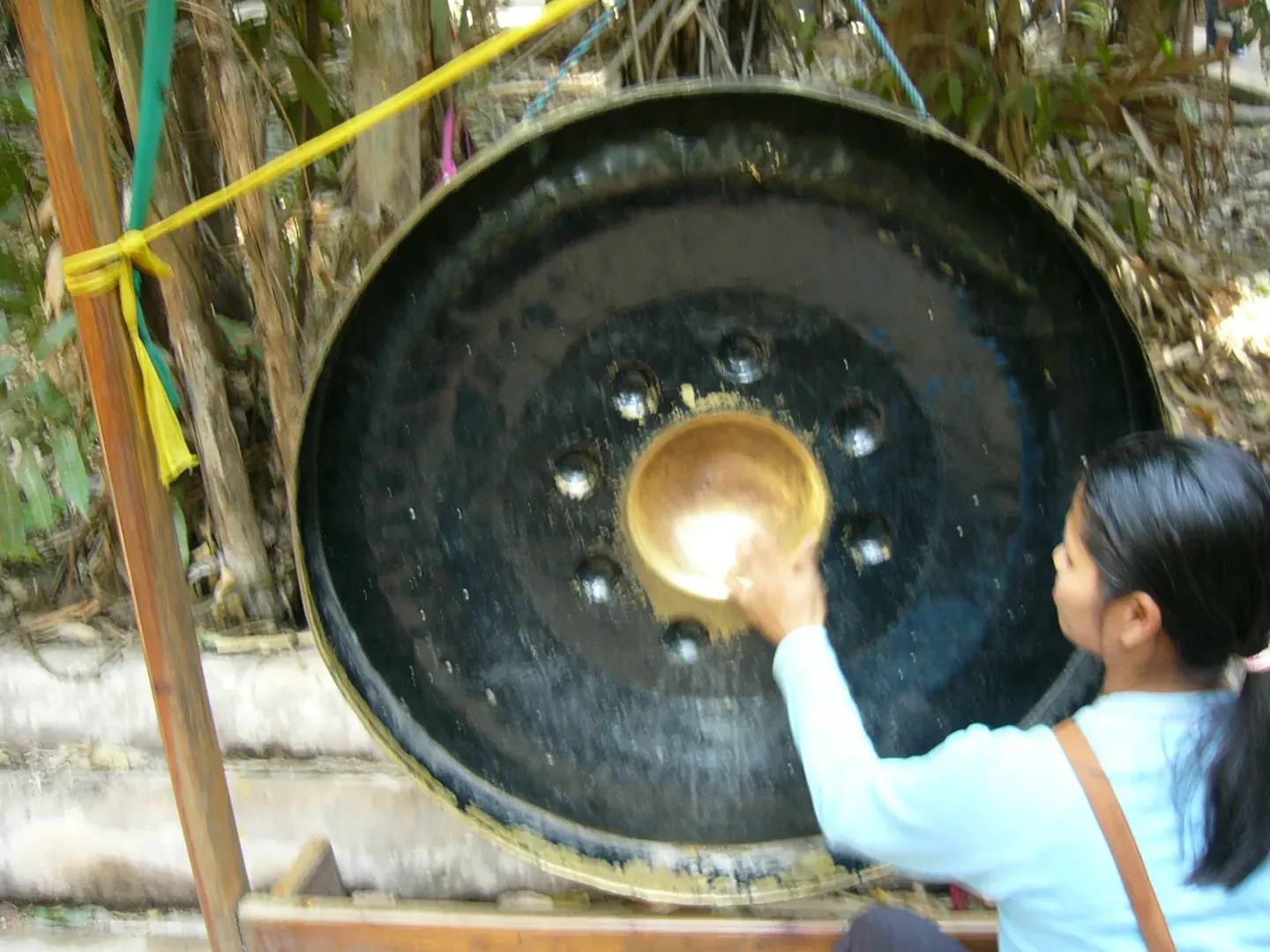


At Kham Chanot, gong rubbing has a particular local devotional setting. The Tourism Authority of Thailand's Connecting to Spiritual Thailand, printed page 52, describes rubbing metal gongs at Kham Chanot in Udon Thani and reports a local belief connecting a sounding gong with fulfillment of a wish.
This is a place-specific account of local religious life, with meaning rooted in its community and setting. The personal listening suggestion above is a separate practice, rather than a reproduction of that rite. At a temple, follow local instructions and touch instruments only where visitors are invited to do so. Our guide to gongs in Thai ritual explores why setting and community matter. For a dated photograph and more about the place, see Kham Chanot’s rubbing gongs.
Choose a gong and begin your practice
Browse the current gongs, choose your finish and size, and order online. The existing sound previews are there if you would like an introduction to the sound. Thai Gongs are handmade to order, so catalogue images and audio are representative and your completed gong will have its own individual character.
Once your gong is part of your space, a suitable padded mallet gives you a clear beginning and a changing sound to follow. Friction remains an optional technique for equipment whose published instructions support it. The intention and attention you bring can give a simple sound personal meaning.
For optional detail, explore how to choose a gong, the size guide, or the wider gong guides. Our returns policy is also available.
Sources & editorial notes
Researched by Thai Gongs Editorial. Sources accessed October 21, 2026. See our editorial approach and research limits.
- Differences between gong mallets and gong friction mallets. Olli Hess. Maker distinguishes rubbed friction heads from padded striking mallets; product-specific claims are not generalized to the catalog.
- Gong Resonant Mallet G-RM-30. Meinl Percussion / Meinl Sonic Energy. Treated rubber head, rubbing application, and relationships between head size, sound range, and required pressure. Therapeutic marketing language is not adopted.
- Crystal Singing Bowl Suede Mallet CSBSML. Meinl Sonic Energy. Circling a smooth bowl rim is a distinct instrument technique.
- Playing the gong: application and instructions. Hess Sound. Light-pressure circular friction technique; used only for equipment whose published instructions support rubbing.
- Gong support and handling. Paiste. Maker acknowledges potential flumi marks and supplies instrument-specific support guidance; no transfer of finish approval to Thai Gongs.
- Care and use of gong mallets and friction mallets. Olli Hess. Dirt, residual cleaning products, and deposits can affect the maker's mallet heads and performance.
- Sound recipe: Intense Plus. Olli Hess. Creator’s accompanying lesson for the embedded friction-mallet demonstration; applies to the specified equipment and is not catalog finish approval.
- Connecting to Spiritual Thailand, printed page 52. Tourism Authority of Thailand. Tourism account of gong rubbing in local wish-related belief and devotional visits to Kham Chanot.