Buying guide
How to Choose a Gong: Size, Sound and Space
Choose the gong you feel drawn to, in a finish you enjoy and a diameter that feels at home in your space. The collection brings those choices together, with representative audio if you would like to hear the sound. You can choose intuitively while understanding a few useful differences in scale, character and handcrafted individuality.
Let personal resonance be part of the choice
A gong can be a musical instrument, a companion to meditation, a focal point for personal ritual or a beautiful presence in a room. Those reasons can overlap. Personal attraction and practical fit can sit comfortably alongside each other.
You may imagine a single stroke opening a period of quiet reflection. You may feel drawn to its shape, its surface or the way a tone seems to linger. You may simply want to explore an instrument that has captured your attention. These are meaningful starting points.
Our recommendation is to let the instrument’s appeal lead, with everyday practicality alongside it. Choose a finish you enjoy seeing and an available diameter that suits where you intend to keep it. The visual size reference offers a straightforward sense of scale. The existing sound previews are there whenever you would like an introduction to the character.
If a gong feels right for your intended practice and its size is comfortable for your space, you have a strong basis for choosing it.
Why the shape matters to the sound
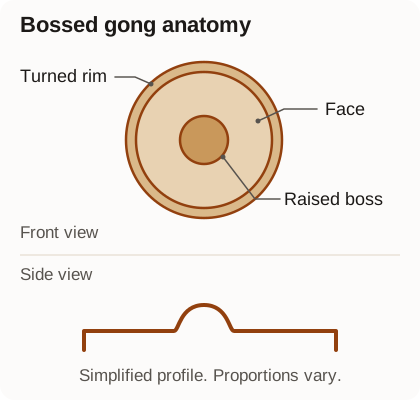
One useful distinction is between a sound with a clear tonal center and a broader wash of sound. Neither is inherently better. A recognizable tone can make an opening or closing stroke feel distinct; a more diffuse sound can be appealing in an unfolding musical texture.
In orchestral terminology, the Vienna Symphonic Library distinguishes the relatively flat, indefinitely pitched tam-tam from a bossed gong with a more definite pitch. This helps explain a contrast between forms without making every gong fit one rigid description.
A boss is the raised central area of a gong. Its shape is part of the instrument’s identity, rather than decoration added to an otherwise identical flat disc. The guide to Thai gongs explores suspended instruments, gong circles and their different musical roles.
For personal ownership, the useful point is simple: different forms offer different musical possibilities. You can appreciate those differences without knowing the name of every overtone. A sound that holds your attention is a worthwhile reason to choose an instrument.
A made-to-order gong has its own voice
Thai Gongs instruments are made to order. You choose from the published finishes and diameters, and your individual instrument takes shape through the making process.
The recordings on the site are representative examples. They introduce a sound character; they are not recordings of the particular gong that will be made for you. Likewise, product photographs show the design and finish character rather than an exact map of the marks on your future instrument.
That individuality is part of owning a handcrafted gong. The aim is a family resemblance you enjoy, with room for your finished instrument’s own response. As you play, its attack, sustained sound and ending become familiar. Your touch becomes part of the relationship too.
This suits open-ended music, personal listening, meditation and ritual especially well: the instrument can become meaningful through use. If a written musical part requires a guaranteed exact note, an instrument expressly sold to that pitch specification is the appropriate choice. For most personal playing, a particular note is not the central decision.
Choose the style and scale you enjoy, then let the experience of ownership develop. There is room to discover your instrument through playing.
Choose size for presence and everyday ease
Diameter is the most immediate way to understand scale. A larger circle makes a stronger visual statement; a smaller one leaves more room around it and is often the more convenient choice when your space has several uses. Both can be intentional, lasting choices.
There is no ladder from a beginner’s small gong to an expert’s large one. A modest instrument may be exactly what you want for an occasional opening sound or a place of quiet reflection. A larger instrument may appeal because you want it to become a focal point in a permanent room.
Diameter also does not specify an exact note. In Neil McLachlan’s gong acoustics research, rim geometry, boss geometry and thickness affected vibrational modes differently. A shaped instrument has more to its sound than its width.
If two available sizes both appeal, our preference is the smaller one for frequent movement or a shared room, and the larger one when visual presence is a priority and space is generous. The centimeter and inch guide explains scale further, but choosing does not require a room calculation or a pitch chart.
What the sound previews can tell you
The existing previews give you a useful introduction to the gong’s character. Some listeners notice the initial contact first; others are drawn to the sustained body or the changing sound as it fades. You can enjoy the recording as a whole and follow whichever quality first draws your attention.
A recording also contains a perspective. DPA’s explanation of close miking shows how microphone placement can change the balance captured from an instrument. Your speakers or headphones contribute to the experience as well.
Gong sound can vary with listening position. Bellows and colleagues’ research on gamelan gongs measured different directional patterns at different frequencies. This is one reason a preview is best understood as an introduction rather than a promise that every room and playback system will sound identical.
The useful takeaway is to enjoy the broad character: a distinct beginning, a full sustained sound, an interesting ending or a quality you find personally resonant. Leave room for your own gong, your playing and your space to contribute something of their own.
Black-Lacquered Thai Gong
Raw-Brass Thai Gong
Appearance is a worthwhile preference
The finish matters because a gong is something you see as well as hear. Its presence may express the intention you bring to a meditation space, complement an interior or make a corner of a room feel personally significant.
Use the published photographs and descriptions to choose the style you prefer. A raw-looking surface and a dark finish offer different visual relationships with wood, light, fabric and other instruments. Aesthetic attraction can be part of personal resonance; it does not need a technical justification.
Explore the raw-brass Thai gong or the black-lacquered Thai gong to choose a published diameter and see its price.
Color and material are separate information. A dark appearance alone does not identify the metal underneath it, and a polished appearance does not establish a particular acoustic result. The product description provides the published identity, while the images help you choose the look.
Enjoy the finish as part of a handcrafted object. Individual surface marks need not reproduce a photograph exactly to create the same overall visual character.
The sound keeps developing through your touch
A purchase is the beginning of learning an instrument. The beater and the way you play are part of its response. Paiste’s mallet guidance identifies mallet size, weight and material as influences on gong sound.
You can begin simply with suitable padded-mallet playing. A small stroke, a comfortable grip and time for the sound to unfold offer plenty to explore. There is no need to collect specialist tools before enjoying the instrument.
Quiet playing is a musical choice in its own right. A single stroke followed by silence can hold a clear place in a personal ritual. Repeated strokes can create a different experience, with sounds overlapping and changing. You can discover which approach belongs in your practice as familiarity grows.
The playing guide is there when you want ideas for that exploration. Ownership gives you time to learn the individual voice of your gong at your own pace.
A few ordinary choices that work well
A gong for home or meditation
Choose a finish you feel drawn to and a diameter that sits comfortably in the room. A gong need not dominate the space to become meaningful within it. The appeal may be a clear beginning to quiet time, a daily ritual or the pleasure of returning to a familiar sound.
A gong for a shared studio
Convenience deserves weight when a room changes between activities. A size that leaves generous space around it is a sensible choice. Being easy to keep in the room can matter more than maximizing its visual impact.
A gong with a permanent presence
When the instrument has a dedicated position, a larger diameter can become a compelling focal point. Choose it because you enjoy that scale, rather than because it represents a supposed next level of practice.
A gong you intend to move
Favor a manageable size and leave room in your budget for appropriate support and protection. A smaller instrument chosen for everyday ease is often the one you will use more regularly.
Choose your finish and size
The collection brings the decision together: the available style, your preferred diameter and the current purchase details. The existing audio is there if you would like it. The ordering FAQ and cancellation and returns policy explain the published terms.
Personal attraction and a comfortable scale are a good basis for choosing an instrument with its own handcrafted voice.
Explore the Thai Gongs collection and choose the instrument you would like to welcome into your space and practice.
Sources & editorial notes
Researched by Thai Gongs Editorial. Sources accessed October 21, 2026. See our editorial approach and research limits.
- Finite Element Analysis and Gong Acoustics. Neil McLachlan · Acoustics Australia, 1997. Experimental and modeled effects of gong geometry and thickness; does not measure the Thai Gongs catalog.
- Modeling the sound radiation of gamelan gongs using analytic rigid spherical models. Bellows, Shepherd, Gee and Leishman · Acoustical Society of America, 2023. Frequency-dependent radiation patterns in the gamelan gongs studied.
- What is close miking & why use it?. Eddy Bøgh Brixen · DPA Microphones. Microphone position and near-field balance affect the recorded perspective of an instrument.
- Gong mallets. Paiste. Mallet size, weight and material affect response; model recommendations are instrument-specific.
- Tam-tam. Vienna Symphonic Library Academy. Orchestral distinction between a tam-tam and a bossed gong.