Ritual and context
Gongs in Thai Ritual: Signals, Ensembles and Local Traditions
Gongs take part in Thai ritual as signals, rhythmic instruments and members of melodic ensembles. Their spiritual and musical meanings belong to the ceremony, musicians and community. Royal court music, Mon-influenced funeral ensembles and regional ritual traditions offer distinct examples, each worth understanding in its own setting.
Listen for meaning, music and ceremony
A gong’s significance can include symbolic meaning, sacred associations and a practical musical role. Two questions help us appreciate those relationships: “What meaning does this community give the sound?” and “What happens when the instrument sounds?” The examples below connect music with transitions, shared participation and religious events.
This guide draws on institutional accounts and named researchers’ work. It offers a starting point for listening, visiting and further reading. The linked sources place each example within the lives and practices of particular communities.
| Context | Documented example | Question for the listener |
|---|---|---|
| Royal ceremony | Khong chai signals and a separate piphat ensemble | Which sound marks a transition, and which music continues? |
| Central Thai funerals | Piphat Mon and ritual repertoire | How does the piece relate to the action underway? |
| Northern Thai cremation | Drum and gong ensembles at Koh Klang Temple | Which stage of this particular ritual is taking place? |
| Southern Kalaw | A studied ensemble of oboe, drums and gong | How do music, recitation and ritual responsibilities interact? |
This comparison framework keeps the examples in view together. Each source offers a particular geographic and social setting, helping us appreciate the variety within Thai ritual life.
Royal ceremony: distinguish a signal from an ensemble part
A Fine Arts Department account of the Emerald Buddha’s seasonal attire ceremony, printed pages 8–10, distinguishes two musical groups. The ceremonial signaling group includes a khong chai, conch and trumpets. A separate piphat ritual ensemble includes a khong wong yai alongside other instruments. The account describes signals and changes of repertoire at stages of the ceremony.
A gong gives a cue while a gong circle participates in the continuing music. Recognizing these roles adds another layer of appreciation for the ceremony’s musical organization. For the physical differences, see our guide to notable Thai gong instruments.
The account shows how an instrument’s ceremonial place grows from shared practice and tradition. Learning about those relationships helps us hear both the individual sounds and the event they belong to.
Central Thai funerals: a relationship between music and action
In Mon Music for Thai Deaths, ethnomusicologist Deborah Wong examines central Thai funerals, especially Bangkok, through research begun in 1994. Her 1998 study describes piphat Mon as combining Thai and Mon instruments and musical influences. Its striking upright gong sets belong to a larger musical and ceremonial setting.
Wong distinguishes secular pieces from ritual repertoire associated with funeral actions. Her analysis explains that a familiar piece can tell participants that monks are arriving or that another stage is beginning. She also examines how performance relates to ethnicity and social status. The account connects musical detail with ritual action and the relationships among people taking part.
This study offers a close view of particular settings in the 1990s. More recent accounts and explanations from people at an event can add to that understanding, allowing for differences in ensemble, sequence and repertoire.
Northern Thailand: follow the stages at Koh Klang Temple
Panupak Mokhasak’s 2021 study in Mahidol Music Journal examines the Prasat Nok Hastilinga cremation ceremony at Koh Klang Temple in Chiang Mai. The article describes a body carrier with an elephant-headed bird structure and distinguishes music during different stages of its construction, celebration and cremation.
The study identifies a local drum ensemble and a gong ensemble called Phat Gong or Pat Gong. It places the gong ensemble in later parts of the ritual, especially the process after cremation, and describes music as signaling stages of the event. The author also discusses adaptation of songs, players and instruments to contemporary local circumstances.
The useful lesson is the specificity: a named ceremony, community, ensemble and sequence of activities to investigate. The account also leaves room for change. A living tradition should be understood through the people who continue to practice and adapt it.
Southern Kalaw: the gong belongs to a larger practice
A 2017 Chulalongkorn University thesis on Kru Sompong Boonmakerd’s Kalaw ensemble uses qualitative fieldwork and interviews. It reports performances principally for monks’ and elders’ funerals in nearby southern provinces, including Krabi and Phatthalung. The study also distinguishes funeral from non-funeral ritual contexts.
Its account brings together rituals, mantra recitation and songs, and describes the oboe accompanied by drums and gong. Hearing the gong as part of this larger practice draws attention to the relationship between the sound, the other performers and the ceremony.
The thesis offers a close account of one ensemble and its inherited practice. Its named musicians, repertoire and research questions provide starting points for a deeper exploration of southern Kalaw music and its ritual settings.
Gong rubbing at Kham Chanot: sound and local belief
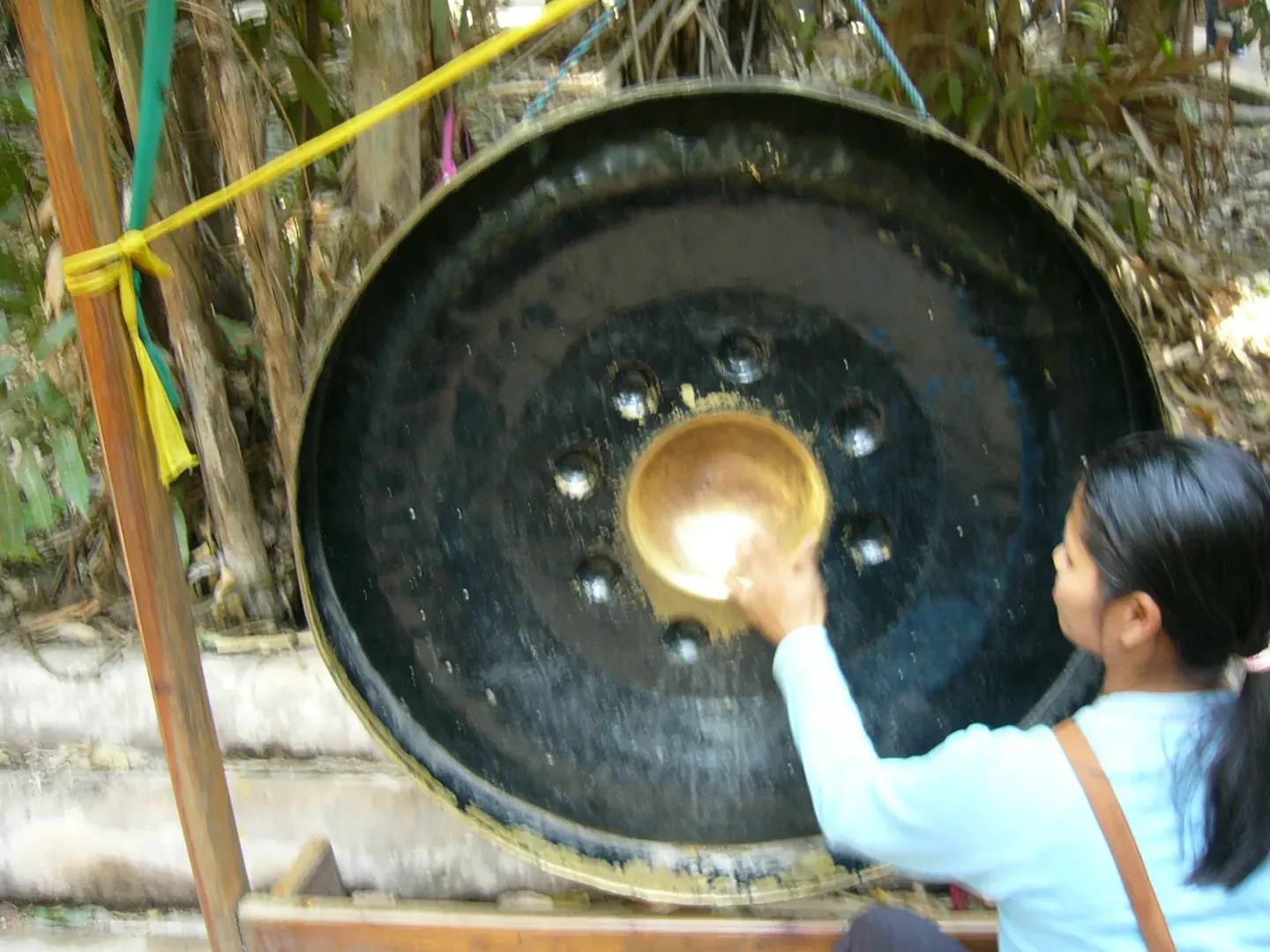


The Tourism Authority of Thailand’s Kham Chanot account, printed page 52, describes rubbing metal gongs to make them sound and reports a local belief connecting success with fulfillment of an earlier wish. The account places this act within the devotional experience of visiting Kham Chanot.
This example has its own local meaning. If friction sound interests you for personal listening or meditation, our gong rubbing guide explains the method and its limits. A personal practice can develop its own intentions while acknowledging the particular setting of the Kham Chanot account. See the photographs and named-place stories in our guide to notable Thai temple gongs.
What this means for your own gong practice
Personal gong practice can carry intention and meaning: marking the beginning of quiet time, listening carefully to a fading tone, or learning to control a soft strike. Your practice may be spiritual, musical, contemplative or a combination. Being clear about its meaning lets you develop a personal ritual while appreciating the distinct traditions described here.
Our view is that attention to purpose makes a practice more thoughtful. Decide what the sound is meant to do in your session. Is it an opening cue? An occasional event you listen to fully? Something you play continuously? Those intentions can guide your choices about space, duration and technique.
For a group, explain the format beforehand and let people choose whether to take part. When drawing on a named religious tradition, learn from people who practice and teach it so that your language and approach reflect an understanding of that tradition.
For your own practice, choose a single gong from our catalogue: select the style and size you like and order online. Existing previews are optional listening, and each handcrafted gong is made to order with individual character. Our buying guide and single-gong playing guide offer more detail whenever you want to explore it. The sources above can deepen your cultural understanding while your own intentions shape the instrument’s place in your practice.
How to listen, visit and keep learning
When visiting a religious site, follow the host’s directions and local signs. Ask permission before playing an instrument or recording people, and give participants space to take part in the event on their own terms.
When sharing what you learn, preserve the details that connect the sound with its setting: the place, community, event, instrument name and source date. Naming the gong ensemble at Koh Klang Temple, for example, helps others explore that particular practice and appreciate its place among other traditions.
To go further, compare the source accounts below. Watch for the relationship between the gong and other musicians, the timing of an entrance and the action around it. That approach keeps the people and the ceremony in view and gives you a more interesting way to listen.
Sources & editorial notes
Researched by Thai Gongs Editorial. Sources accessed October 21, 2026. See our editorial approach and research limits.
- Music in the royal ceremony of changing the Emerald Buddha’s seasonal attire, pp. 8–10. Thailand Fine Arts Department, Sannasara Silpakorn 2020, volume 1; author ธำมรงค์ บุญราช. Khong chai in ceremonial signals and khong wong yai in the separate piphat ritual ensemble.
- Mon Music for Thai Deaths: Ethnicity and Status in Thai Urban Funerals (1998). Deborah Wong, Asian Folklore Studies; full text hosted by National Taiwan University. Original fieldwork on central Thai funerals, combined Thai and Mon instrumentation, and ritual repertoire. Historical study, not a current national census.
- Music in the Prasat Nok Hastilinga Cremation Ceremony in Koh Klang Temple, Mueang District, Chiang Mai Province (2021). Panupak Mokhasak, Mahidol Music Journal 4(1), 6–24. Specific Northern Thai temple study: drum and gong ensembles, stages of cremation, and musical signals.
- Rituals and Beliefs of Kalaw Music by Kru Sompong Boonmakerd (2017). ปานตา ศรีคง, Chulalongkorn University thesis. Qualitative fieldwork with one southern Kalaw ensemble, funeral and other ritual contexts, and oboe/drum/gong instrumentation.
- Connecting to Spiritual Thailand, Kham Chanot, printed p. 52. Tourism Authority of Thailand. Tourism account of gong rubbing within local wish-related belief and devotional visits to Kham Chanot.