Temple gongs and sacred places
Notable Gongs at Thai Temples: Four Places and Their Stories
Some Thai gongs are memorable because of the places, offerings and devotional acts they belong to. These four examples lead from a dated inscription in Lamphun to a monumental temple landmark in Ubon Ratchathani, rubbing gongs at Kham Chanot and a gong sounded during worship at Phra That Sajja. Their stories offer several ways to appreciate the instrument’s spiritual presence.
Four places, four different stories
Our selection favors a particular gong or documented group at a named place. A dedication, a ceremony or a local act of devotion can tell us more about an instrument’s significance than a size ranking. The sources below give each example a distinct setting.
| Place | Province | What makes the gong noteworthy |
|---|---|---|
| Wat Phra That Hariphunchai | Lamphun | An inscribed gong records an offering cast in 1860. |
| Wat Tham Khuha Sawan | Ubon Ratchathani | A large gong is a landmark within the riverside temple compound. |
| Kham Chanot, associated with Wat Sirisuttho | Udon Thani | A series of gongs appears in an account of rubbing and local wish-related belief. |
| Phra That Sajja at Wat Lat Pu Songtham | Loei | Gong sounding appears in visitor devotion and a documented annual observance. |
The stories also differ in the kind of record they leave. Hariphunchai gives us words inscribed on an object. Kham Chanot brings together a visitor account and a dated photograph. At Phra That Sajja, an event report lets us place the gong within an actual ceremony. Those differences are part of their interest.
Wat Phra That Hariphunchai: an offering with its story inscribed
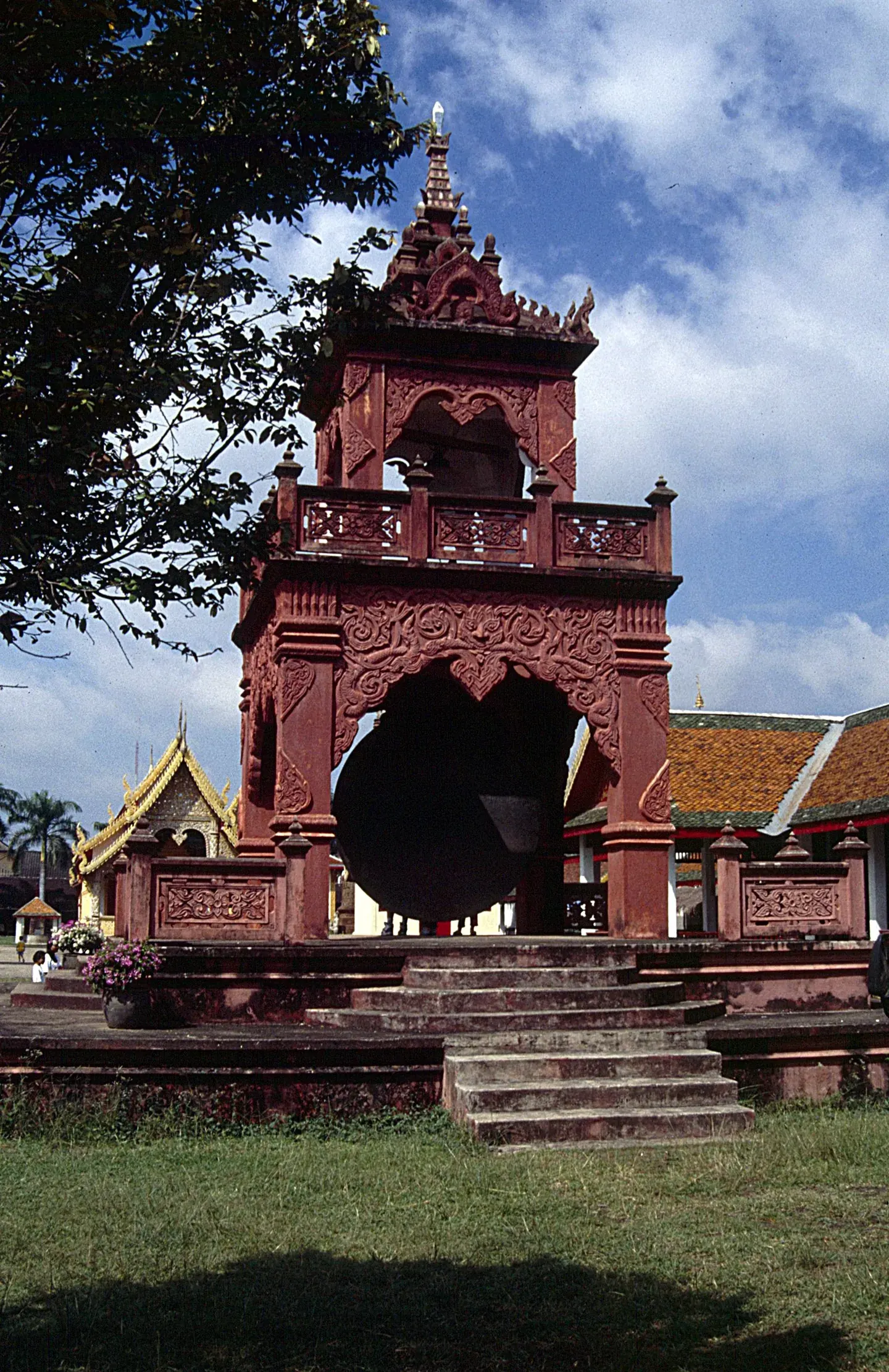

One documented gong at Wat Phra That Hariphunchai in Lamphun has an unusually tangible history. The Anthropology Centre’s inscription record identifies the object as a gong, gives its diameter as 229 centimeters and dates its inscription to Buddhist Era 2403, corresponding to 1860. It records ten lines on one face and locates the object in the temple’s gong pavilion.
The record’s account brings together a monk from Phrae, Chiang Mai’s ruler and monastic and lay donors. They cast the gong at Wat Phra Singh in Chiang Mai as an offering to the sacred relic at Hariphunchai. The instrument therefore carries a story of people giving together, with a dedication that connects its making to its destination.
The Lamphun Cultural Office’s account of the pavilion calls it the bell tower of three cities, linking Phrae, Chiang Mai and Lamphun. It describes a two-level structure with a bell above and the large gong below. The building gives the instrument an architectural place as well as a devotional one.
That cultural account also relates local Lanna meanings of sounding bells and gongs: sharing the news of merit with departed ancestors and honoring Buddhist qualities. In its explanation of three soundings, wisdom, compassion and purity are among the qualities recalled. These are meanings attributed to this cultural setting, where an audible act can carry an intention beyond the person sounding it.
This is the example we would start with for the story. The scale is striking, but the dedication makes the object especially memorable. Its inscription brings particular donors and a particular offering into view, giving a visitor something enduring to appreciate even in a quiet moment beside the pavilion.
Wat Tham Khuha Sawan: a large gong in a Mekong landscape
At Wat Tham Khuha Sawan in Khong Chiam, Ubon Ratchathani, the gong becomes a prominent landmark in a larger sacred landscape. A Thailand Tourism Directory route through the area specifically names the temple’s large gong alongside its chedi, ornamental planting and viewpoints over the rivers and surrounding settlements.
The Tourism Authority of Thailand’s temple account places the temple in Ban Dan subdistrict. It describes its founding in 1978 by the meditation master Luang Pu Kham Khaning Chumani, together with the white ordination hall, Phra Dhamma Chedi Sri Trai Phum and a viewpoint across the Mekong toward Laos. These details give the gong a setting within a place associated with meditation, devotion and the river landscape.
The temple’s foundation date belongs to the temple history. The sources used here do not establish a casting date, measured diameter or particular ceremonial repertoire for the gong. Its place in this selection rests on the identified object and its prominence in the compound.
For us, the appeal is the change of scale between an instrument held in someone’s attention and a form that helps define a place. A gong can be encountered as sound, as an offering and as a powerful visual presence. Here, the large circular form sits within a wider experience of temple architecture and an expansive river setting.
The gong belongs within the temple’s whole story. Its visual presence becomes more interesting alongside the spaces of worship and meditation and the landscape described in the temple account. Together, they offer several ways to appreciate this place.
Kham Chanot: rubbing gongs within naga devotion


Kham Chanot in Udon Thani is a sacred site associated with Wat Sirisuttho. In Connecting to Spiritual Thailand, printed page 52, the Tourism Authority of Thailand describes the palm-covered island and devotion to the naga grandparents Sri Suttho and Sri Pathumma. Garlands and elaborate banana-leaf offerings form part of the account.
The same account describes a series of metal gongs encountered during the visit. It reports a local belief that making a gong sound by rubbing it is connected with fulfillment of a wish made earlier. The act belongs to the devotional journey described at Kham Chanot, giving the sound a particular place in the visit.
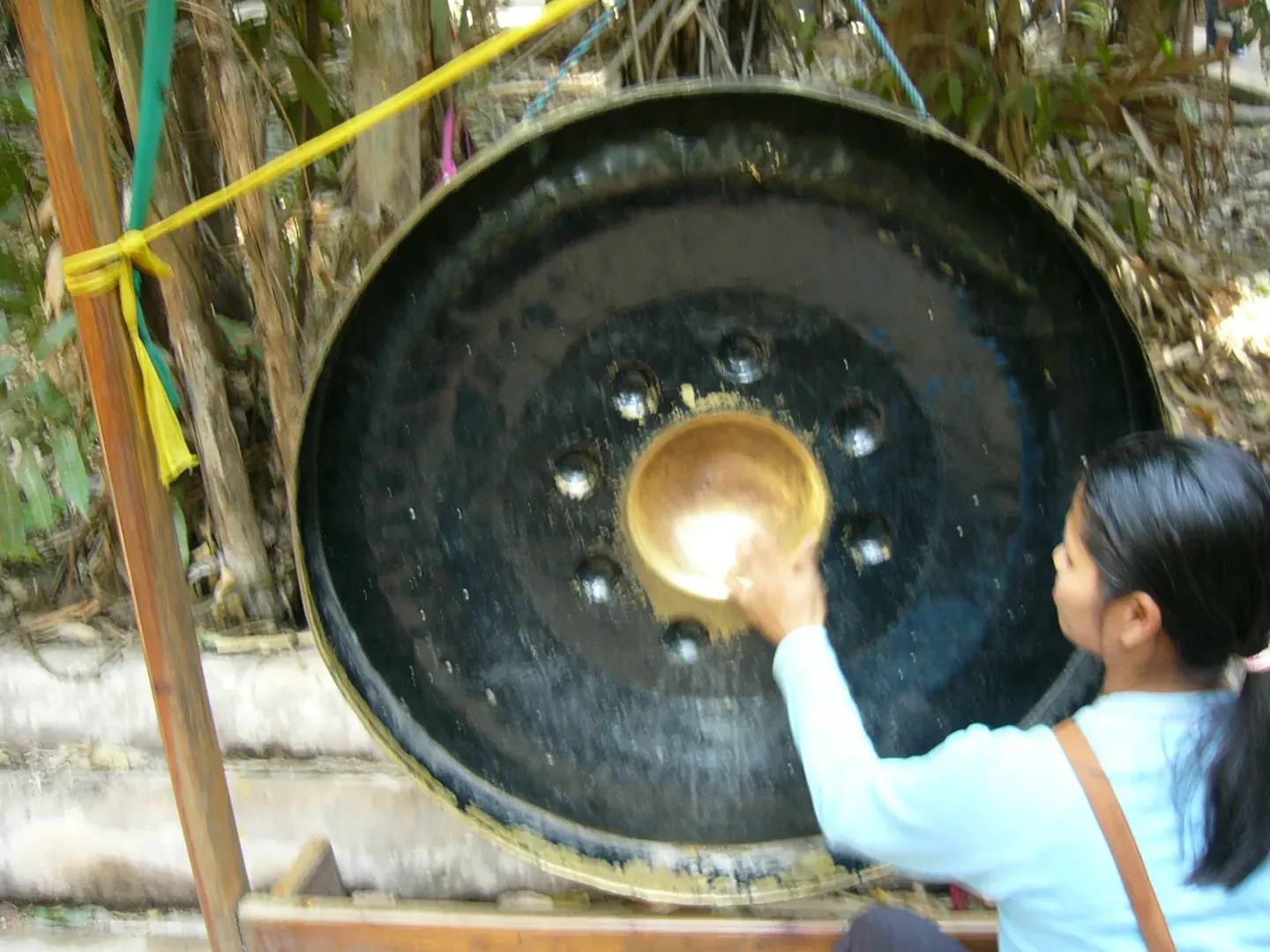
A photograph by Mattes dated February 10, 2007 provides another glimpse of a gong there. The photographer identifies the location as Wat Kham Chanot near Ban Dung. The image shows a visitor’s hand at the bright central boss of a dark hanging gong, with smaller raised bosses around it. It is a dated view of one instrument and one moment of participation.
That close view is a useful companion to the larger temple landmarks. The hand, the center of the gong and the person’s attention become the focus. For a reader interested in the spiritual nature of gongs, this is a particular encounter between an instrument, an intention and a sacred setting.
Our guide to rubbing a gong for meditation explores friction as a separate playing topic. The Kham Chanot example has its own local meaning; a personal listening practice can develop its own intentions while appreciating the place that this account describes.
Phra That Sajja: a gong sounded in worship and community observance
Phra That Sajja stands at Wat Lat Pu Songtham in Tha Li, Loei. The official Thailand Tourism Directory entry identifies a large gong within the grounds, sounded by visitors before they go to worship at the stupa. It reports a local belief associating the act with the blessings of the sacred beings who protect the relic and with hopes for happiness and flourishing.
A separate Government Public Relations Department report published on February 18, 2025 places a large gong within the annual Phra That Sajja observance. Its account of the morning activities includes the ceremonial sounding of a large gong and large bell, offerings and a dance offering by people from villages across Tha Li.
The report describes participation from the Thai side and neighboring Laos, with monks and community representatives taking part in the observance. The gong appears within an occasion of worship and shared participation, among several acts through which the community honors the sacred site.
These two accounts give the place an especially interesting story. One describes a visitor’s individual act of devotion. The other records a communal ceremony at a particular time. Gong sounding appears at both scales of participation: the person arriving with an intention, and the gathering of people for an observance held together.
There is no need to know its exact age or weight to find that relationship compelling. The documented sounding, the place and the occasion make this more than an anonymous object in a temple photograph. It is a gong with an audible role in a named community’s religious life.
What makes a temple gong memorable
Our preference is to keep the story close to the place. The Hariphunchai gong carries a dedication. The large gong at Khuha Sawan forms part of a temple landscape. At Kham Chanot, rubbing appears within a devotional visit. At Phra That Sajja, sounding the gong belongs to individual and communal observance.
Those stories let spiritual meaning and material presence remain together. The object has a surface, a scale and a setting, while people bring intentions, offerings and traditions to their encounters with it. That relationship gives these examples their depth.
During a visit, follow the temple or site’s current directions about touching, sounding and photographing instruments. A quiet look at a gong can be meaningful too. Leave space for people taking part in worship, and let their use of the place set the pace.
For more context, explore gongs in Thai ritual or the types of Thai gongs. If you would like an individual instrument for your own practice, browse our single gongs, choose a style and size, and order online. Existing previews are optional, and each gong is handcrafted to order with its own character.
Sources & editorial notes
Researched by Thai Gongs Editorial. Sources accessed October 21, 2026. See our editorial approach and research limits.
- จารึกกังสดาล: Kangsadan inscription, record 2023. Princess Maha Chakri Sirindhorn Anthropology Centre, Inscriptions in Thailand Database. Object record, inscription date, diameter, casting place, donors and dedication at Wat Phra That Hariphunchai.
- หอกังสดาล: The gong pavilion. Lamphun Provincial Cultural Office, Ministry of Culture Cultural Information Center. Pavilion arrangement, Three Cities connection and locally attributed meanings of sounding the gong. The inscription date follows the Anthropology Centre record.
- Tourism route including Wat Tham Khuha Sawan. Thailand Tourism Directory, government-hosted destination entry. Names the large gong at the Khong Chiam temple and places it among the compound’s landmarks. This route entry is not an object catalogue or verified size record.
- Wat Tham Khuha Sawan, official temple destination account. Tourism Authority of Thailand. Temple location, meditation founder, white ubosot, chedi and Mekong viewpoint. The temple’s foundation date is not assigned to its gong.
- Connecting to Spiritual Thailand, Kham Chanot, printed page 52. Tourism Authority of Thailand. Wat Sirisuttho visitor location, naga devotion and a series of rubbing gongs associated with a locally reported wish-related belief.
- Gong and buddhist woman, photograph dated February 10, 2007. Mattes, own-work photograph published on Wikimedia Commons. Dated visual record of a visitor touching a hanging gong at the location the photographer identifies as Wat Kham Chanot near Ban Dung. Public-domain release verified separately.
- พระธาตุสัจจะ: Phra That Sajja. Thailand Digital Tourism Center, official Thailand Tourism Directory entry. Identifies the large gong and reports the local belief associated with sounding it before worship at the stupa.
- Tha Li and Lao participants continue the Phra That Sajja observance, February 2025. Thailand Government Public Relations Department, Radio Thailand Loei; reporter สุรีรักษ์ อัยยะจักร์. First-party event report published February 18, 2025, documenting the sounding of a large gong and large bell during the observance at Wat Lat Pu Songtham.